Colonoscopies vs At-Home Stool Tests
1When individuals reach age 45, the CDC recommends that they begin to receive regular colonoscopy screenings. A colonoscopy is a way to screen for the development of colorectal cancer and is one of the most effective ways to either rule out colorectal cancer or to take action by detecting and removing precancerous polyps. A colonoscopy is a crucial procedure as cancers that are discovered earlier have a higher chance of being cured. The same test is recommended every ten years until age 75, if nothing unusual is discovered and if there is no family history of colorectal cancer.
The question is, how does one decide if they should get a colonoscopy or use an at-home stool test? This is something that we will explore today.
Colonoscopy
The first question that you might have about a colonoscopy is what exactly this procedure is. As recommended by the American Cancer Society, colonoscopies should begin at age 45. A colonoscopy is performed to detect cancer or a polyp that might turn into colon cancer.
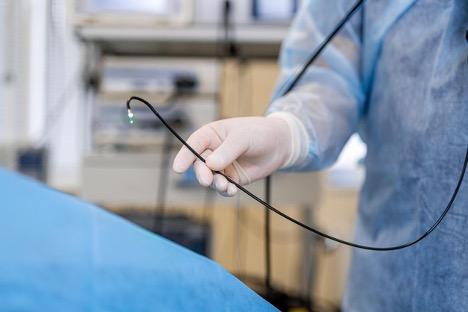
The procedure involves inserting a flexible and thin tube with a camera and a light into the rectum to examine the colon. Some patients report slight discomfort when they receive this procedure. However, much of that discomfort has been eliminated via the modern way that this procedure is performed. Doctors and hospitals have worked diligently to take away as much of the pain and difficulties that people used to face when they received a colonoscopy. At any rate, even some slight discomfort is worthwhile, given the benefits of the test.
Following a colonoscopy, a doctor will perform a comprehensive analysis of the results to determine if cancer is detected, and if so, what the best treatment plan will be. If precancerous polyps are detected, the doctor will devise a plan for the frequency of colonoscopy. If no polyps are detected, the doctor will typically recommend another colonoscopy in 10 years.
Home Screenings
Some patients opt for the easier-to-use and less expensive alternative of an at-home stool test. Yale Medicine provides details about the existence of these tests and why some see them as a favorable alternative:
The good news is that there are home tests that doctors recommend to certain “average risk” patients. These fecal immunochemical tests (FIT) are mailed to your home and contain instructions and materials to take a small sample and send it to a laboratory for testing.
To be considered an “average risk” patient, the individual must not have any of the following:
1. Family history of colon cancer
2. A history of polyps
3. Conditions that predispose them to colon cancer such as a family history of colon cancer
Which Test Is Best?
Each individual should speak with their doctor before making any determination about which type of screening is the most appropriate in their own case. It is often the case that a traditional colonoscopy procedure is still the best option for many. At the very least, the procedure is the default that most doctors recommend. It can provide them with the most information and minimize the risk of missing potential cancer issues.
At-home tests are still useful in certain cases. If the patient is considered “average-risk”, then it might be less burdensome for that patient to do their own in-home test. Thus, it encourages certain patients to follow through with their screening as opposed to no screening at all. Some patients will refuse to get a colonoscopy. They might agree to an at-home screening, and that is certainly better than no screening at all.
In addition, at-home screenings are generally less costly than a colonoscopy. We understand that some patients may be concerned about the cost of the colonoscopy, but many insurance carriers cover the procedure in full. The patient should call their insurance company to find out about their coverage.
Why Screenings Matter
Doctors recently came out in mass to reinforce the fact that colonoscopies save patients’ lives. They wanted it to be abundantly clear that the early detection of polyps and other worrying signs of potential cancer is extremely important.
In 2018, Kaiser Permanente performed a study in which they discovered a 67% reduction in cancer deaths among patients who received a screening colonoscopy. Cancers that are detected earlier have a better chance of being cured. It doesn’t guarantee that the cancer patient will survive their disease, but it gives that patient additional hope because they are provided with more treatment options than they would be if they didn’t have cancer detected until later.
Anything that one can do to reduce their chances of developing late-stage cancer is worth pursuing. Thus, these screenings are well worth the trouble of getting them.
Determining Which Screening Type Is Right for You
Every patient should consult with their doctor about which type of colonoscopy screening is right for them. Your doctor will likely ask a number of questions about your medical history to help determine which type of screening is appropriate in their case. That doctor will want to access if there is a family history of colorectal cancer and a few other factors before offering a recommendation between colonoscopy vs. at-home stool tests.
Patients that want the peace of mind of the most complete type of screening possible should seek a colonoscopy. This will provide them the best possible chance of finding precancerous polyps and having them removed at the time of colonoscopy.
The potential issue with taking an at-home test is that something could get missed. If it is, then cancer could be allowed to continue to grow unabated. That may put the patient at additional risk down the road. It is a very good reason to at least consider going for a traditional colonoscopy to get everything taken care of fully. Check with your insurance company about your coverage for screening colonoscopy.
At Allied Digestive Health (ADH), we’re an integrated network of gastroenterology centers committed to providing our patients with the highest quality care. Our team of board-certified gastroenterologists, nurse practitioners, physician assistants, dietitians, and support staff work together to create personalized treatment plans for each patient. So, we invite you to contact us today to schedule your screening.